
This post may contain affiliate links. As an Amazon Associate, I earn from qualifying purchases - at no extra cost to you.
Discover 17 garage shelving ideas for heavy bins, tools, seasonal gear, and bulky items, with smart layouts, load ratings, and space-saving designs.
A garage can have plenty of vertical space and still feel completely packed.
The usual problem is that everything is stored at the same level: the floor. Bins sit beside the car, tools pile up in corners, and bulky seasonal items become impossible to reach without moving three other things first.
The right Garage shelving ideas change that by turning unused vertical air into useful, load-bearing storage.
The key is not simply buying the tallest shelf you can find. You need to match shelf type, depth, mounting method, spacing, and rated capacity to what you actually store.
According to OSHA storage guidance, stored materials should be secured against sliding, falling, or collapse, and storage should never exceed applicable safe load limits. OSHA: General Requirements for Storage
2. How much shelf space do you have?
🧱 What Should You Consider Before Choosing Garage Shelving Ideas?
Start with the items, then choose the shelving. Your shelves should fit the weight, size, depth, and frequency of use of the things you plan to store.
Measure these five things before shopping:
- Available wall width
- Maximum shelf depth
- Ceiling height
- Vehicle and door clearance
- Weight of the heaviest items
Depth deserves special attention.
A shelf that is too shallow leaves storage bins hanging over the edge. A shelf that is too deep can create hidden rows of clutter.
This Old House recommends considering shelf dimensions based on the objects being stored and notes that 48 by 16 inch shelves work well for many common garage items such as plastic totes and toolboxes. It also recommends roughly 18 inches of vertical space between shelves for taller items and access. This Old House: DIY Garage Shelves
🏗️ What Are the Best Garage Shelving Ideas for Heavy and Bulky Storage?
The best shelving system depends on what you need to store and how much weight each level must carry. The 17 options below cover steel, wire, wood, modular, wall-mounted, freestanding, rail-based, and overhead structures.
1. 🏋️ Heavy-Duty Freestanding Steel Shelving

A weak shelf becomes expensive the moment a loaded bin punches through it.
Heavy-duty steel shelving solves that problem by giving bulky garage items a rigid frame and high load rating. As one current example, Gladiator’s 48-inch-wide, 18-inch-deep heavy-duty rack is rated for 2,000 pounds per shelf and 8,000 pounds for the complete four-shelf unit. Gladiator Heavy-Duty Rack
The cost difference can also make sense. A lighter five-tier boltless rack listed at Home Depot was about $106 when checked, while premium heavy-duty steel systems can cost considerably more. Example boltless steel shelving
You are paying for stronger construction, deeper storage, and higher capacity rather than fancy decoration.
Load per shelf: Up to 2,000 lbs on the cited Gladiator model
Mounting: Freestanding
Depth: 18 inches
Why it works: High load capacity makes it suitable for dense, heavy garage storage.
2. 🔧 Wall-Mounted Adjustable Shelving Rails
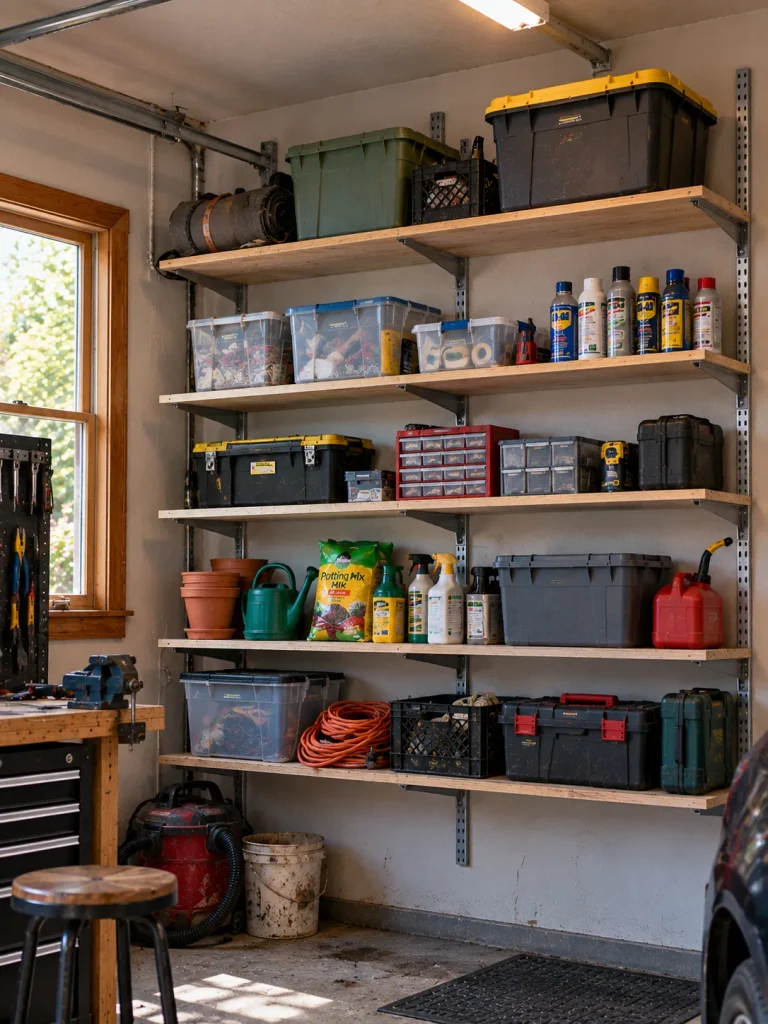
Two vertical rails, adjustable brackets, and shelf boards create a system that can change as your garage changes.
The brackets slot into the rail at multiple heights, so you can raise one shelf for tall storage bins and lower another for shorter containers.
That is the major advantage over fixed shelving. You are not locked into one spacing pattern.
Lowe’s notes that wall shelving can save floor space and that adjustable systems allow storage heights to be changed around different items. Lowe’s Garage Storage Buying Guide
The caveat is structural support. Wall-mounted systems must be installed according to their specific requirements, and heavy loads may require attachment to studs or other suitable framing.
Shelf type: Adjustable steel rails with shelf boards
Mounting: Wall-mounted rail
Load capacity: Product-specific; verify the rail and bracket rating
Best use: Changing collections of bins, tools, and supplies
Verdict: Adjustability is worth paying for when your garage storage needs change every season.
3. ☁️ Ceiling-Mounted Overhead Shelf Racks

The most common mistake with overhead garage shelving is treating the ceiling like an infinite-strength storage surface.
It is not.
A ceiling rack transfers the load into joists or other structural members, so the installation matters as much as the rack itself. For example, one Fleximounts 4-by-8-foot system is rated for 600 pounds total and is designed to mount into traditional wood ceiling joists. Fleximounts overhead rack specifications
Never assume drywall can carry the load.
You also need to check garage-door movement before installation. The rack must not interfere with an open door or moving hardware.
Shelf type: Steel overhead platform
Mounting: Ceiling-mounted
Load capacity: 600 lbs total on the cited model
Best use: Seasonal bins, camping gear, holiday decorations
The mistake to avoid is loading it first and checking the structure later.
4. 📐 Corner Shelving Units
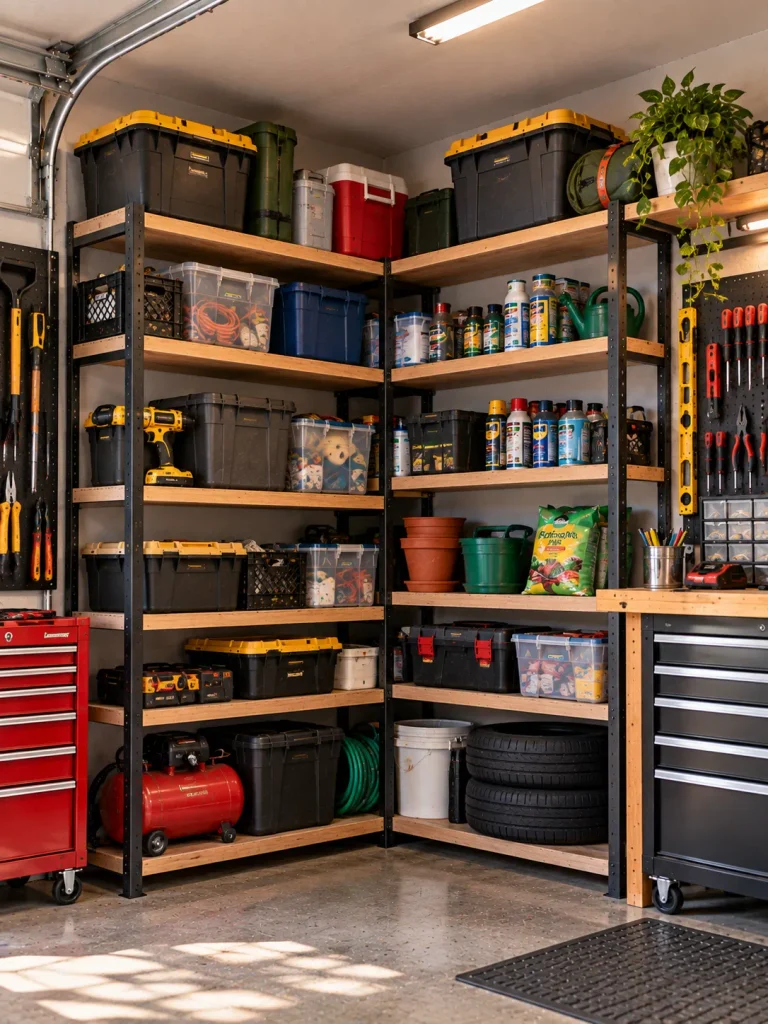
It’s Saturday morning, you are reorganizing the garage, and the middle of the room looks better already.
Then you reach the corner.
There is an awkward empty triangle where a standard rectangular shelving unit cannot fit properly. That dead zone can hold a surprising amount of storage when you use a dedicated corner shelf.
Corner shelving turns two walls into one storage zone without blocking the center of the garage.
A current Seville Classics corner steel shelf measures about 28 by 28 inches and is rated at 600 pounds per shelf on leveling feet. Seville Classics Corner Steel Shelf
Load: 600 lbs/shelf on cited model | Depth: 28 in | Best for: Bins, tools, paint supplies, bulky corner items
The trick is to use the corner for items that do not need constant access.
5. 🪜 Tiered Step Shelving Garage
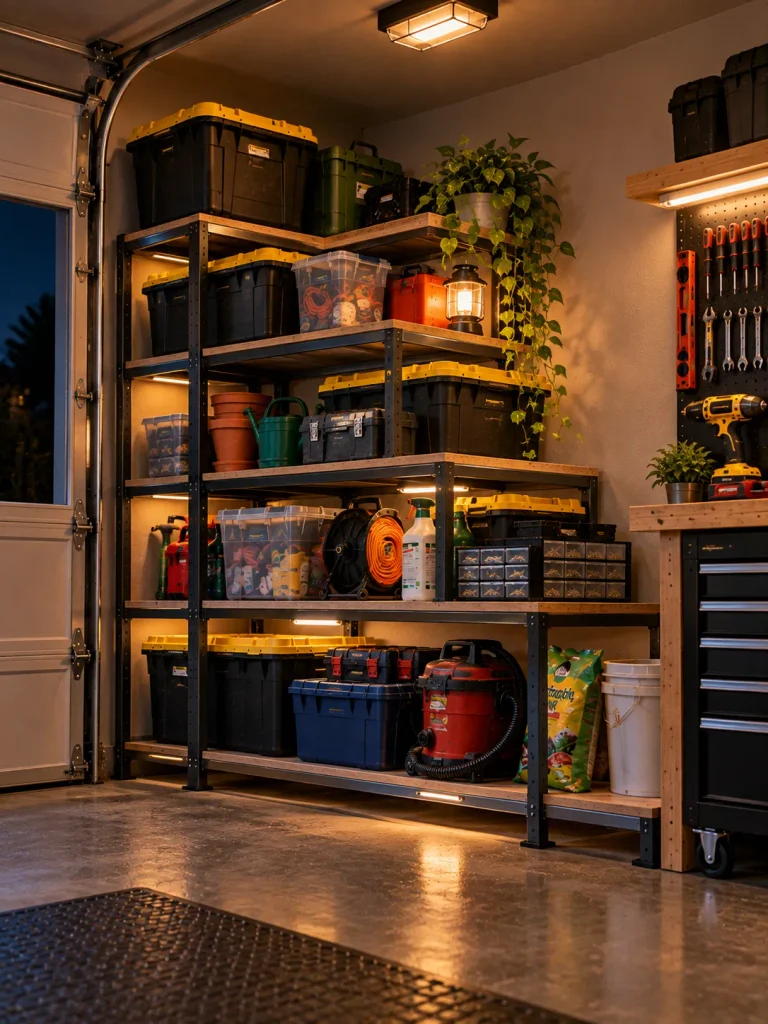
You know the problem: the front bin is easy to grab, but the one behind it has disappeared from civilization.
Tiered shelving fixes the visibility problem by raising each level progressively toward the back.
That stepped shape works especially well for paint cans, storage boxes, small tool cases, and containers that would otherwise hide behind one another.
A tiered arrangement can also make labels easier to read because each row sits slightly higher than the one in front.
Do not assume one universal load rating exists for tiered shelving. The capacity depends on the actual frame and shelf material, so use the manufacturer’s rating for your model.
Shelf type: Tiered steel or reinforced board
Mounting: Freestanding
Load capacity: Varies by model; use the manufacturer’s per-shelf rating
Best use: Small bins, paint cans, labeled containers
Depth: Typically 12 to 24 inches
The payoff is simple: more visibility with less digging.
6. 🧺 Industrial Wire Shelving

Unlike solid wood shelving, industrial wire shelving lets air move around stored items and makes it easier to see what is underneath.
That makes it useful for garage containers, tools, automotive supplies, and items that may benefit from airflow.
It can also be easier to clean than a solid shelf.
Seville Classics, for example, lists a commercial-grade steel wire shelf with a 600-pound capacity per shelf and an 18-inch depth. Seville Classics UltraDurable Steel Wire Shelf
Wire shelving can cost more than basic DIY lumber, but it offers a more finished modular system.
Choose wire when visibility and airflow matter. Choose solid shelving when you need a completely flat surface for small loose objects.
Verdict: Pick wire when airflow, visibility, and adjustability matter more than having a solid deck.
7. 🔨 Wall-Mounted Floating Shelves

You will need a stud finder, level, drill, screws, and the correct mounting hardware.
Step one: mark the stud locations and draw a level line at your intended shelf height.
Step two: drill pilot holes and secure the mounting cleat or brackets into the appropriate structural points.
Step three: attach the shelf and test it before loading it.
For heavy garage storage, do not treat decorative floating-shelf hardware like industrial shelving hardware.
The shelf depth should also match your containers. A 10-inch shelf is fine for small boxes but frustrating when your storage totes are 18 inches deep.
Shelf type: Wood, plywood, MDF, or engineered shelf with structural brackets
Mounting: Wall-mounted
Load capacity: Varies by bracket and installation
Best use: Lightweight to medium supplies, bins, tools, décor
The result is clean storage with almost no visual bulk below the shelf.
8. 📦 Deep Bin Shelving Racks
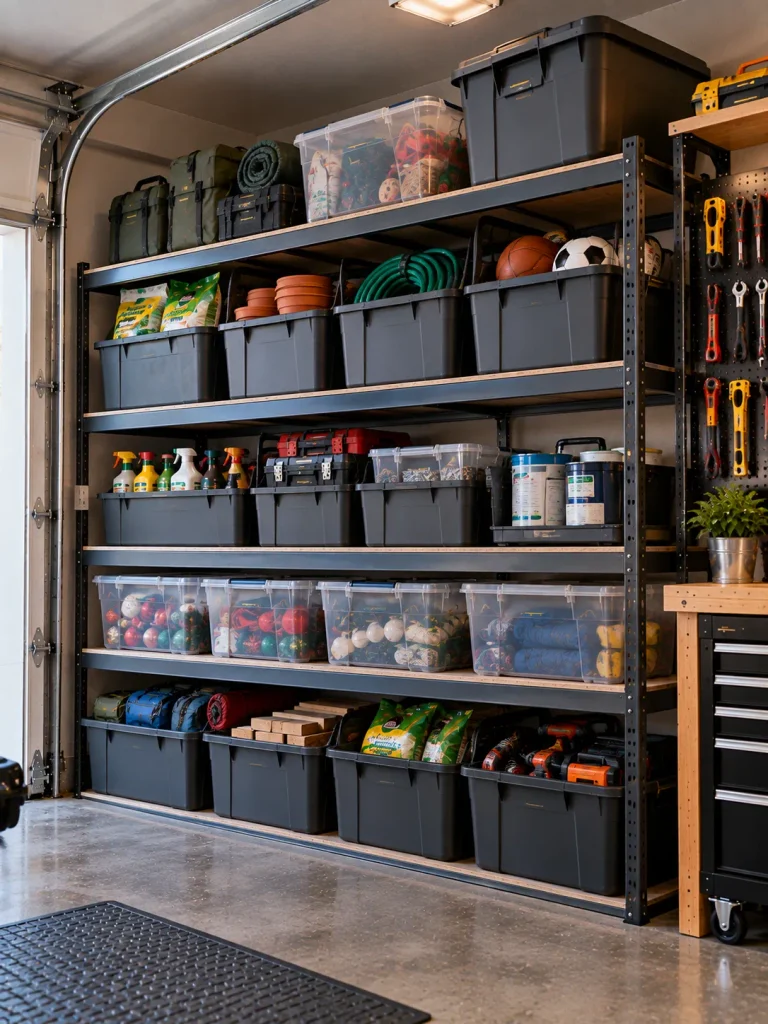
Buy deep shelving for deep bins.
A shallow shelf forces large storage totes to hang over the edge. That wastes usable space and creates an annoying lip that makes containers harder to pull out.
An 18 to 24-inch-deep rack is usually more practical for large garage totes, coolers, toolboxes, and bulky seasonal equipment.
This Old House specifically warns that very deep shelves can create a second hidden layer of objects, so depth should match both the container and your access needs. This Old House Garage Storage Planning Guide
Load: 500 to 1,000+ lbs/shelf depending on system | Depth: 18 to 24 in | Best for: Large bins, coolers, toolboxes, seasonal décor
Skip an oversized deep rack if your garage walkway is already tight.
9. 🛞 Sliding Track Shelving
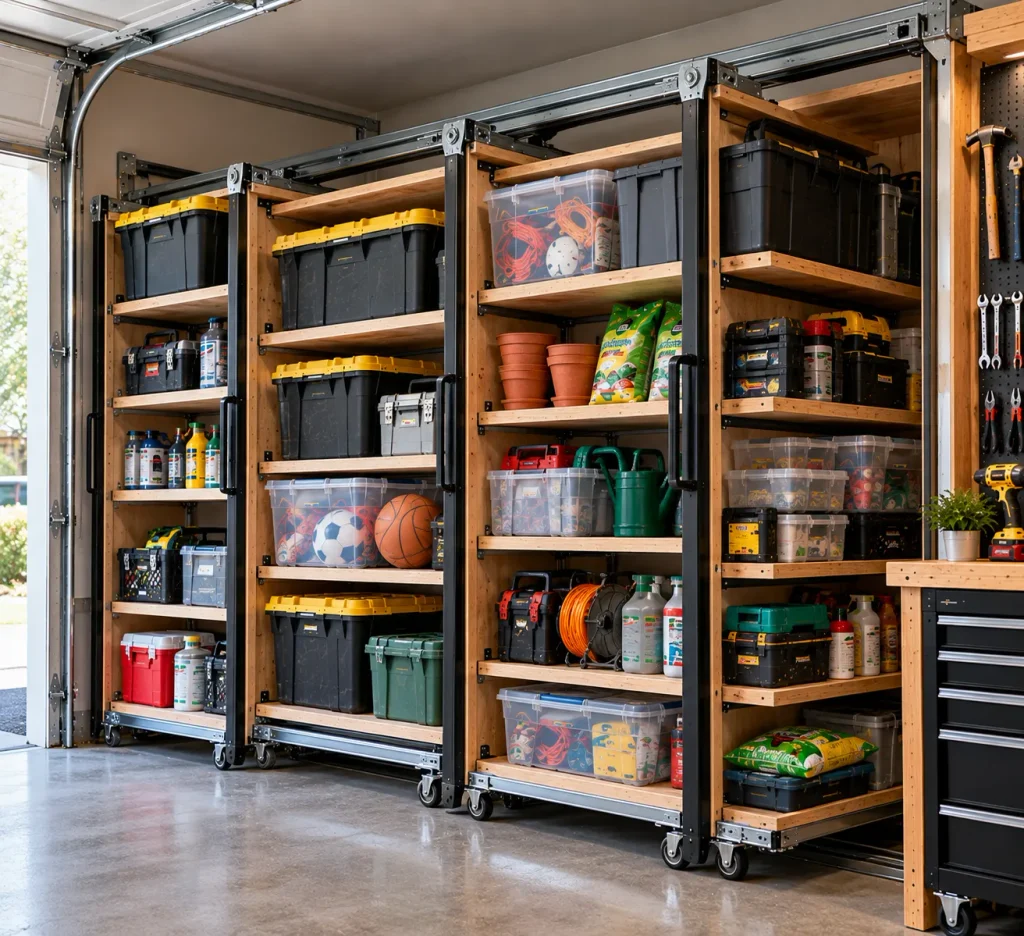
The mechanism is simple: shelves or shelf frames move along a mounted track so you can reposition the storage instead of rebuilding it.
That makes sliding track shelving useful when your garage has several categories that change throughout the year.
One month, the lower shelf might need space for camping containers. A few months later, you may want that same section for gardening equipment.
The rail carries the structure, while the shelves provide the actual storage surface.
The important caveat is that not every track system is designed for the same load. Treat the manufacturer’s rating as the limit, not a suggestion.
Load per shelf: Product-specific; verify rail and bracket rating
Mounting: Wall rail
Depth: Usually 12 to 24 inches
Why it works: Shelves can be repositioned without rebuilding the entire storage wall.
It is a particularly good choice for households whose storage needs refuse to sit still.
10. 📏 Narrow Gap Shelving Units
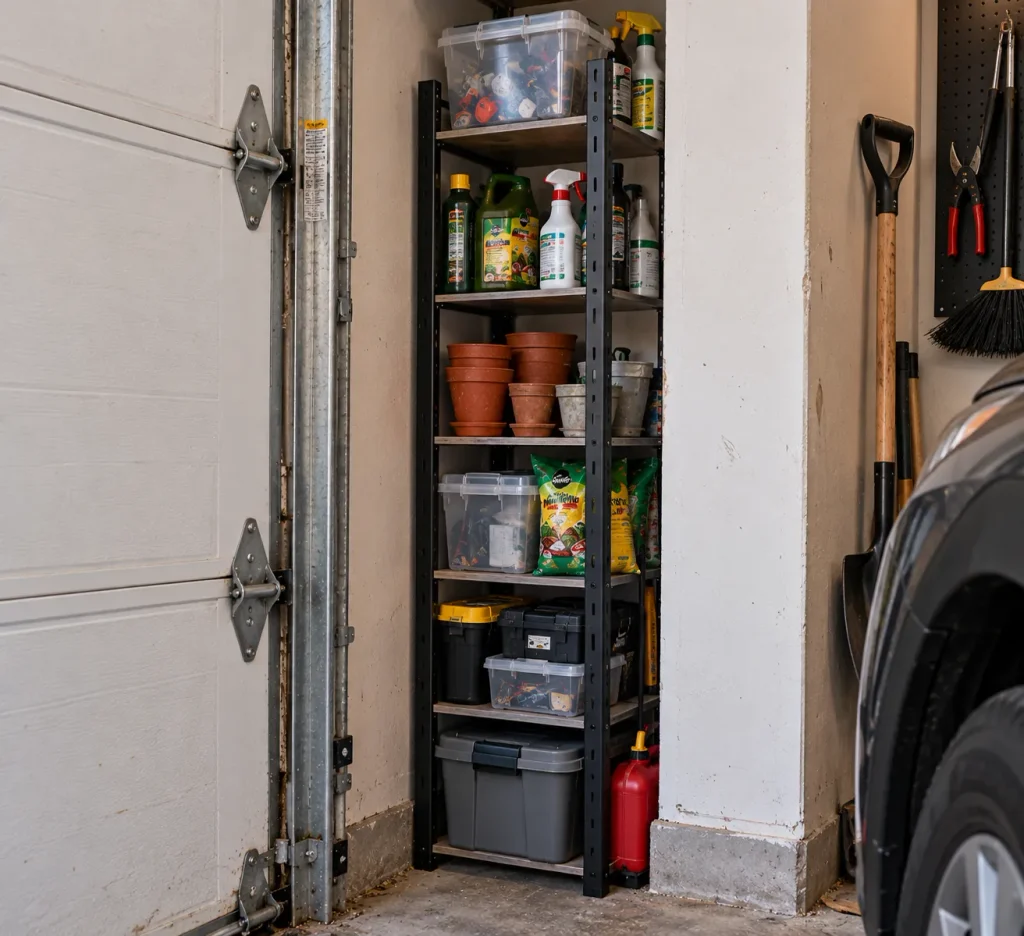
A narrow gap is easy to ignore because a normal shelf will not fit.
That is exactly why a narrow shelving unit can be valuable.
Measure the space between the garage door frame and a wall, beside a workbench, or between larger storage sections. A slim rack can turn that leftover strip into storage for spray cans, small bins, gardening supplies, or hand tools.
For comparison, a current compact Seville cabinet configuration uses a 16.5-inch interior depth and adjustable shelving, showing how narrower storage can be designed around restricted footprints. Seville Classics narrow garage storage
A purpose-built narrow unit can cost around $100 or more depending on material and capacity, but that can be cheaper than losing an entire wall section to unusable space.
Verdict: Spend the money when a 10 to 16-inch gap is otherwise dead space; skip it when the same area can hold a full-depth rack.
11. 🛠️ Workbench + Shelf Combo

It is Saturday afternoon, you are repairing something at the workbench, and every tool you need is sitting somewhere else.
You walk to the shelf, grab the drill, return to the bench, then realize the screws are still across the garage.
A workbench-and-shelf combination fixes that workflow by putting the working surface and storage in one vertical zone.
Look for designs where shelves sit above or beside the work surface. The lower section stays open for your legs and equipment while the upper shelves carry tools, boxes, and supplies.
Shelf type: Steel, wood, or hybrid shelving over work surface
Mounting: Freestanding or wall-secured depending on model
Load capacity: Varies by shelf and workbench system
Best use: Workshops, DIY projects, tool storage
The best version keeps your tools within arm’s reach without turning the workbench into another pile.
12. 📚 High-Low Split Shelving

You reach for the high shelf, realize the box is heavier than expected, and immediately regret putting it there.
High-low shelving prevents that mistake by dividing storage according to weight and frequency.
Put dense items such as tools, automotive fluids, and heavy hardware on the lower shelves. Reserve higher shelves for lighter seasonal decorations, empty containers, and infrequently used gear.
OSHA guidance on shelving safety recommends storing heavy items on lower shelves and avoiding unstable stacking on upper levels. OSHA shelving safety guidance
Load: Product-specific | Depth: 16 to 24 in | Best for: Heavy items below, lightweight seasonal gear above
The layout is safer, easier to access, and less likely to turn a tall rack into a top-heavy mess.
13. 🧊 Modular Cube Shelving Garage
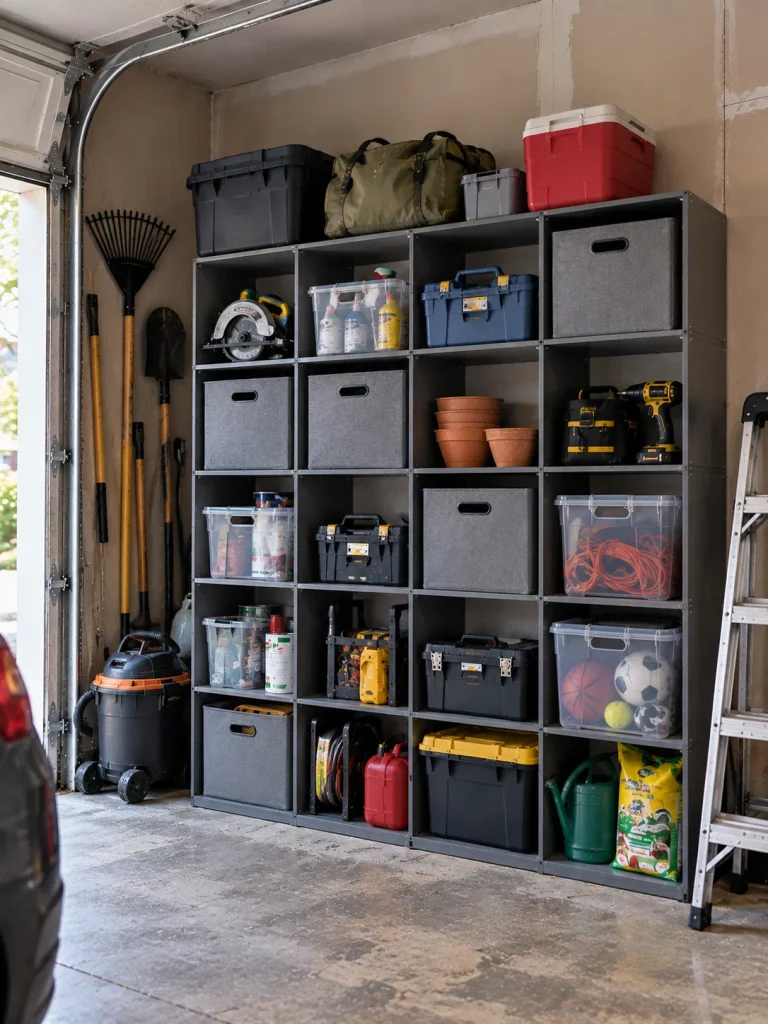
Start with the tools: tape measure, level, drill, and appropriate anchors if the system requires wall restraint.
Step one: build the cube modules according to the manufacturer’s instructions.
Step two: arrange the cubes around the sizes of your bins rather than forcing every opening to hold the same item.
Step three: secure the unit when required and load heavier contents toward the lower levels.
Cube shelving is not automatically heavy-duty. Some modular systems are designed for clothing or light household storage, while reinforced steel cube systems can handle much more.
Shelf type: Modular cube panels or steel cube frames
Mounting: Freestanding, with wall restraint where required
Load capacity: Model-specific; verify each cube’s rating
Depth: Commonly 12 to 16 inches
Why it works: Individual compartments prevent one giant shelf from becoming a mixed pile.
The result is a highly customizable storage wall that works best when your garage inventory comes in many small categories.
14. 🔩 Boltless Rivet Shelving
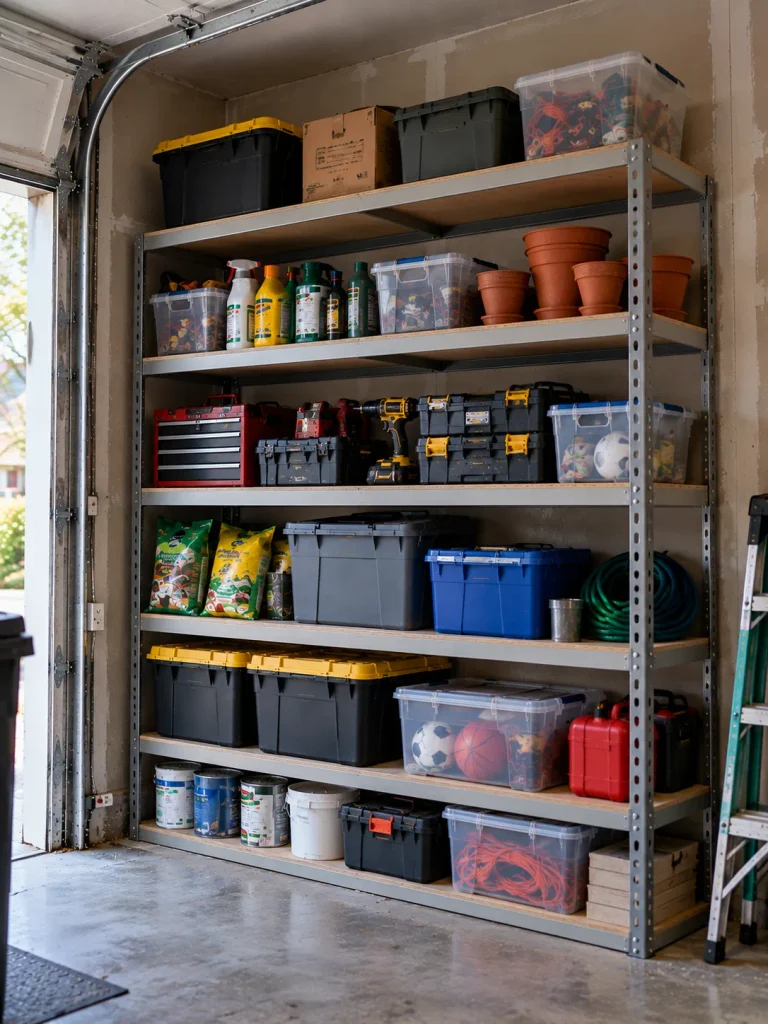
Unlike traditional bolted shelving, boltless rivet systems use rivets, beams, and locking connections to assemble the frame quickly.
That can reduce assembly time while still giving you a steel structure designed for heavy storage.
A current boltless steel example from Home Depot is listed at 450 pounds per shelf, with adjustable shelf heights and a 2,250-pound total capacity. Example boltless garage shelving
The advantage is not that every boltless rack carries 450 pounds. It is that this style can offer serious capacity while remaining easier to assemble than conventional bolted frames.
Verdict: Choose boltless rivet shelving when fast assembly and adjustable heavy storage matter more than a furniture-like finish.
15. 🧺 Shelving With Integrated Bin Rails

The most common way people ruin this type of shelving is by treating every shelf like a flat dumping surface.
Once loose bins start sliding around, labels disappear and the shelf becomes another clutter zone.
Integrated rails change that by giving containers a defined position.
The rail can stop plastic bins from shifting forward while also creating a visual boundary between categories.
This is particularly useful for small garages where shelves need to hold many containers without letting everything migrate toward the front edge.
Shelf type: Steel or composite shelving with integrated retaining rails
Mounting: Freestanding or wall-supported depending on model
Load capacity: Manufacturer-specific
Best use: Plastic bins, parts boxes, labeled containers
The result is a shelf that controls the storage instead of simply providing a flat place to pile it.
16. 🛞 Retractable Rolling Shelf Unit

Mobility beats permanence here.
A retractable rolling shelf lets you move the entire storage unit when you need access behind it or need a temporary open workspace.
That makes it useful for garages that double as workshops.
The key is choosing locking casters or a design that becomes stable when parked. A rolling shelf should not behave like a shopping cart when you are trying to retrieve a heavy toolbox.
Load: Product-specific; verify per-shelf rating | Depth: 16 to 24 in | Best for: Tools, workshop supplies, movable storage
Skip this design if you rarely need to move your shelves. A stationary heavy-duty rack usually gives you more capacity for the money.
17. 🚪 Overhead Garage Door Track Shelving

The space above a garage door is easy to overlook because the door itself occupies that area when open.
A ceiling-mounted shelf can use that otherwise awkward zone, but clearance must come first.
Fleximounts recommends raising the garage door and measuring downward when positioning an overhead rack, with its installation guide advising about six inches of clearance from the open door to the rack. Fleximounts Overhead Rack Installation Guide
A current 3-by-8-foot Fleximounts model is rated at 600 pounds total and installs 22 to 40 inches below the ceiling. Fleximounts 600-lb overhead rack
The cost is justified when the ceiling area would otherwise remain completely unused.
Load per shelf: 600 lbs total platform capacity on cited model
Mounting: Ceiling
Depth: 36 inches on cited 3-by-8-foot model
Why it works: Uses otherwise wasted overhead space without adding another floor footprint.
📊 Which Garage Shelving Ideas Work Best for Different Storage Problems?
There is no single best shelf for every garage. The right choice depends on whether you care most about capacity, flexibility, accessibility, or making use of an awkward space.
| Storage problem | Best shelving direction |
|---|---|
| Very heavy bins | Heavy-duty steel |
| Changing shelf heights | Adjustable rails |
| Seasonal items | Overhead racks |
| Wasted corner | Corner shelving |
| Small containers | Tiered or modular shelving |
| Airflow needed | Wire shelving |
| Workshop tools | Workbench + shelf |
| Deep storage totes | Deep bin rack |
| Narrow unused strip | Narrow shelving |
| Fast assembly | Boltless rivet shelving |
| Frequently changing layout | Sliding track |
| Small categorized items | Cube shelving |
The important distinction is capacity versus convenience.
A 2,000-pound-rated rack is impressive, but you may not need that much capacity. On the other hand, buying a light-duty shelf for heavy tools because it looks attractive is a false economy.
⚖️ How Much Weight Should Garage Shelving Hold?
Never choose a shelf based only on its appearance or overall unit capacity. Look specifically for the rated capacity per shelf and check the conditions attached to that rating.
For example, Gladiator lists 2,000 pounds per shelf on one of its heavy-duty racks, while Seville Classics lists 600 pounds per shelf on a particular steel wire shelf. Those numbers belong to those specific products and should not be generalized to every steel or wire rack.
Also check whether the rating assumes:
- Evenly distributed weight
- Leveling feet
- No wheels
- Specific shelf spacing
- Specific assembly
- Specific mounting hardware
Some manufacturers reduce the permitted load when a shelving unit is placed on casters rather than leveling feet. Seville Classics, for example, lists different total capacities for one of its units depending on whether it is on leveling feet or wheels. Seville Classics UltraDurable shelving specification.
🏁 Which Garage Shelving Ideas Should You Choose?
Choose the shelving structure that matches your actual storage problem, not the shelf with the biggest number on the box. Heavy steel works for serious loads, adjustable rails handle changing needs, wire improves visibility and airflow, and modular systems help divide smaller items.
For heavy bins, start with a properly rated steel rack.
For changing collections, look at adjustable rails or modular shelving.
For awkward corners, use a purpose-built corner unit.
For narrow gaps, use a slim rack rather than wasting the entire strip.
For workshop areas, combine shelving with a workbench.
For seasonal items, overhead shelving can use otherwise wasted air, provided the ceiling structure and garage-door clearance are suitable.
And always remember the most important number on any shelving product:
The actual rated capacity for the specific shelf under the manufacturer’s stated installation conditions.
Your goal is not simply to build a taller garage.
It is to build a smarter one.